

About the Pan-African Data Project
An overview of the Pan-African Data Project’s goals, methods, and data sources
The Pan-African Data Project (PADP) brings together historical research and digital methods to trace the people, organizations, and events that have shaped Pan-Africanism since the late 19th century. Through data curation and visualization, the project highlights the global networks of Black liberation and solidarity that link Africa and its diasporas. Drawing on archival and scholarly sources, it offers searchable, interactive views — maps, tables, and timelines — that reveal the scope and connections of Pan-African collaboration across nations, communities, and generations. The PADP also includes data from Afro-Asian internationalist events to reflect relationships that have evolved between interconnected movements. As newly independent African states emerged in the mid-twentieth century, they began developing continental Pan-African connections and engaged with Afro-Asian alliances and the Non-Aligned Movement to pursue shared goals of sovereignty, economic justice, and solidarity while resisting the influence of the U.S. and the Soviet Union. Since the end of the Cold War, Pan-Africanism has taken new shape. The PADP draws on extensive historical research documenting figures, organizations, and events related to Pan-Africanism. Primary sources include conference proceedings, newspapers and periodicals, contemporary academic publications, and declassified government documents. Secondary sources incorporate books and journal articles on Pan-Africanism, as well as data shared by our partner, the Afro-Asian Networks project. More information about our data is available on the Posts page in the menu. If you are a descendant or family member of an individual in the PADP and have concerns about accuracy, representation, or context, you may request a review by contacting Roopika Risam at Dartmouth College. The project team evaluates all requests in good faith, prioritizing privacy, dignity, and historical integrity.
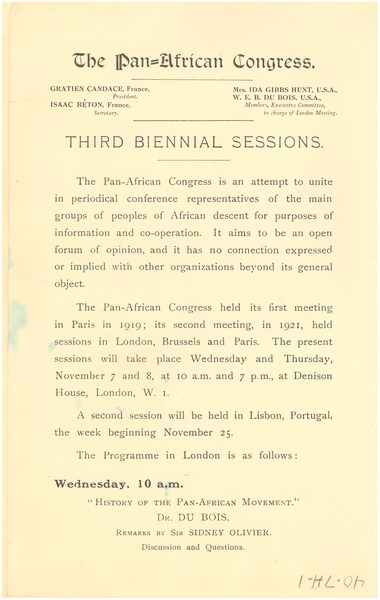
Program for the London sessions of the Third Pan-African Congress, 1923. Public domain.
Technical Specifications
The PADP website draws on Performant Studio, a suite of open-source technologies designed by Performant Software Solutions. The data is managed using Performant's FairData object graph management framework. The backend for the website uses TinaCMS, an open-source content management system. The PADP is proud to have partnered with Performant to develop new open-source components — including timelines, tabular data views, faceted search, data exports, browser-saved searches, data vizualization embeds in posts, and static deployment to Reclaim Hosting — which can be reused in other digital projects.
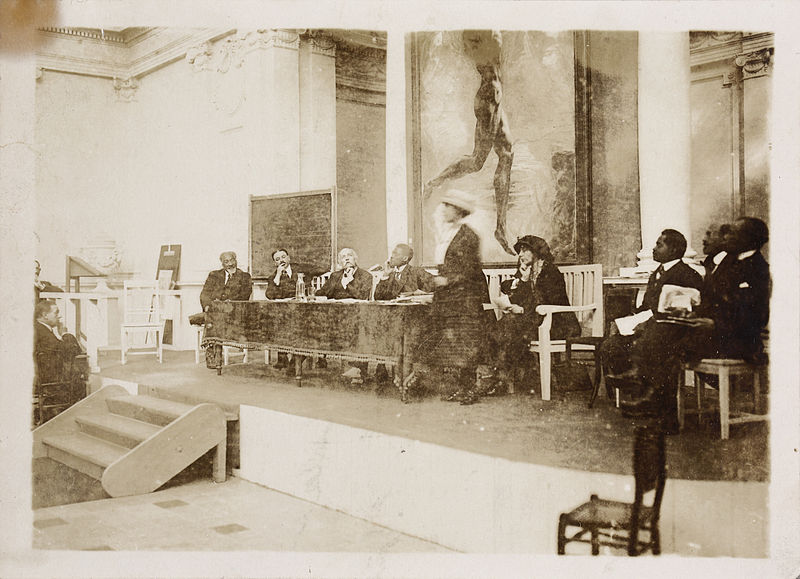
The Second Pan-African Congress, Brussels, 1921. Public domain.
Our Supporters



Licensing
The Pan-African Data Project © 2025 by Roopika Risam et al. is licensed under CC BY-NC 4.0. We encourage reuse and remixing of the project and its data.
Citation
To cite this page, please use: Risam, Roopika, et al. 2025. "About the Pan-African Data Project." The Pan-African Data Project. https://www.panafricandata.org/en/pages/about-padp/.